
Article: Damaged Skin Barrier? Signs to Watch For and a Simple 4-Step Repair Routine

Damaged Skin Barrier? Signs to Watch For and a Simple 4-Step Repair Routine
If your face stings when you apply products, feels tight after washing, or suddenly reacts to things it used to tolerate, your skin barrier may be asking for help. The good news: a weakened barrier can often benefit from a simpler, gentler routine.
The routine at a glance: Cleanse gently → Apply serum → Moisturize → Protect with sunscreen in the morning.
What is the skin barrier?
Your skin barrier is the outermost layer of your skin. It helps hold moisture in and keep irritants, pollution and allergens out. Ceramides are natural fats that act like the mortar between skin cells. Cleveland Clinic notes that ceramides make up about 50% of the skin's outer layer. When ceramide levels drop, skin can lose water faster and become dry, itchy and reactive.
Signs your skin barrier may be damaged
- Stinging or burning when you apply skincare
- Tightness right after washing your face
- Redness, flaking or rough patches
- Sudden sensitivity to products you have used for months
- Dryness that a light moisturizer does not fix
- Breakouts that get worse as skin gets more irritated
What damages it?
Common causes include over-cleansing, harsh foaming cleansers, too many exfoliating acids or scrubs, and starting strong actives too fast. Sun exposure, dry air, air conditioning and pollution can add to the stress.
A simple 4-step barrier repair routine
When your barrier is weak, less is more. Pause scrubs and strong acids, and keep your routine gentle. Only use products your skin tolerates.
1. Cleanse gently
Morning and night, use the Seevoke Hydrating & Barrier Repair Cleanser. It is soap-free and sulfate-free, with Ceramide Complex, D-Panthenol and Sodium Hyaluronate.
Massage a small amount onto a damp face for 30–60 seconds, rinse well and pat dry. Do not rub with a towel.
2. Treat with a serum
Apply 2–3 drops of the Seevoke Advanced Barrier Repair Face Serum to your face and neck. It pairs Ceramide Complex with Niacinamide, an ingredient studied for its role in supporting the skin's own production of ceramides.
3. Moisturize to lock it in
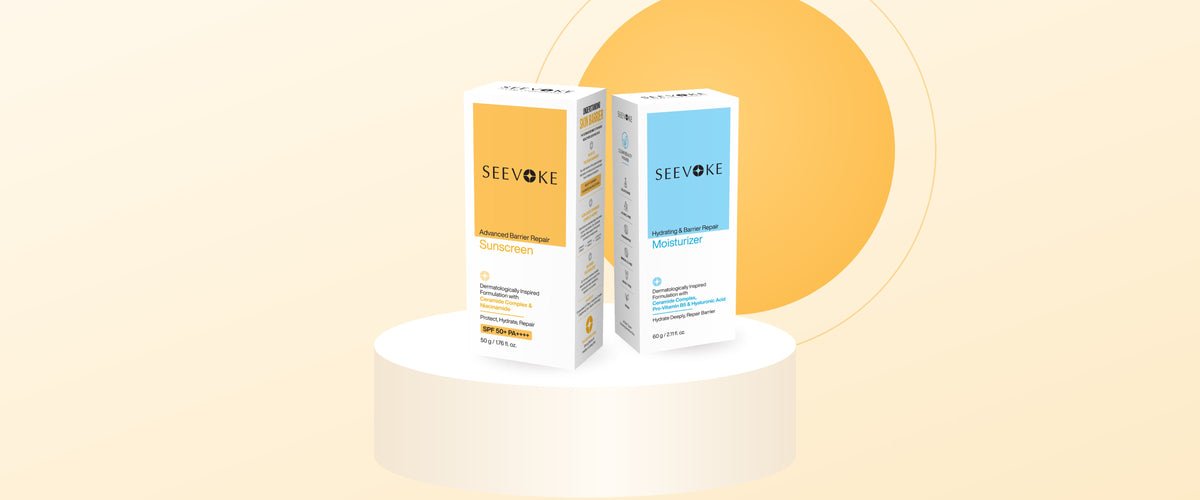
Massage the Seevoke Hydrating & Barrier Repair Moisturizer into your skin until absorbed. Its Ceramide Complex, Shea Butter, Pro-Vitamin B5 and Hyaluronic Acid help replenish moisture and support the barrier.
4. Protect every morning
Finish with the Seevoke Advanced Barrier Repair Sunscreen SPF 50+ PA++++. UV exposure can weaken the barrier, so daily sunscreen is an important part of your routine. Follow the product label for application and reapplication.
Your evening routine: Follow steps 1 to 3 and skip sunscreen.
Tips to support recovery
- Keep water lukewarm. Hot water can strip natural oils.
- Moisturize after washing. Apply within 3 minutes, while skin is still slightly damp.
- Introduce one new product at a time. This makes it easier to notice what your skin tolerates.
- Be consistent, but listen to your skin. Improvement can take weeks. Stop products that worsen irritation rather than pushing through it.
Frequently asked questions
Can I use these products if I have sensitive skin?
The Seevoke range is formulated for all skin types, including sensitive skin, and is sulfate-free, paraben-free and mineral oil-free. Individual reactions can still happen. Patch test any new product on your inner arm first, and stop use if irritation occurs.
When can I go back to exfoliants or retinol?
Once stinging, tightness and redness have settled, reintroduce actives one at a time and start slowly, a few nights a week as tolerated. If irritation returns, pause and seek advice from a dermatologist.
When should I see a dermatologist?
If irritation is severe, painful or does not improve, or you have eczema, rosacea or another skin condition, see a dermatologist.
Ready to care for your barrier?
Explore the Seevoke Barrier Repair range and build a simple routine around gentle cleansing, hydration and daily sun protection.
This article is for general skincare education and is not a substitute for medical advice.